🃏 How to choose your electives
The 3 principles and strategies to choose elective subjects in your final year.

Which elective subjects should I choose?
Many of my juniors used to seek my advice on this. From my own experience and observation, I noticed a common thinking pattern that students often use to help them decide. It typically boils down to 3 seemingly contrasting principles. Either 1) choose the ones easiest to score, 2) choose the ones relevant for your future career, or 3) choose the most diverse subjects.
In this post, I’ll dissect each principle and discuss how we can strategize our decision-making process. If you're also pondering on how to choose your electives, this might help you develop your answers too.
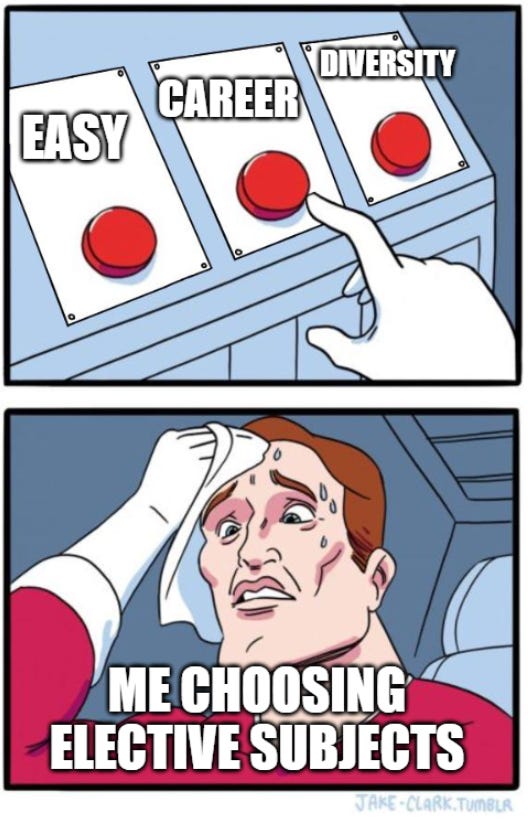
But before that, a few notes to keep in mind:
These principles are not arranged in preferential order.
These principles are not exclusive and absolute, so they can be a combination of each other and taken partially.
These principles are ideas, they are not the only way of making decisions in life.
Let's go. The first principle.
1. Choose the easiest to score
This seems to be the most popular philosophy for many students, but not necessarily the ideal choice. Understandably, though. Most students take electives in their final year and this is also when these 3 interrelated rants occur:
I need to really focus on my FYP Perhaps you’ve had issues with your final year project (FYP), like a change of topic, change of supervisor, or delayed progress that requires extra commitment to patch things up.
I am too exhausted Perhaps you’re at the brink of giving up, after struggling with your studies all these prior years. Finally, a chance to relieve the burden a bit.
I really need to improve my CGPA Perhaps your cumulative grade point average (CGPA) has been quite disappointing lately, and you want to graduate with better pointers. Or, to let graduation even be possible in the first place.
Now, hold on. Aren't all those typical lazy student excuses? Indeed they could be. But they could also be valid, rational, real-life considerations. This discussion isn't a remedy for poor attitude, but rather, an invitation to reflect on one's own situation. So putting poor attitude aside, how to choose the easy ones?
Ask your seniors They have gone through it. Typically, individual responses can be heavily biased. Ask a few of them, at least, and evaluate the common traits and experiences. And of course, ask them their results and compare them with their perceived effort and academic talent.
Identify the most generous lecturer Generosity has a diverse definition. It could be in sharing knowledge, tips, and even motivation. Lecturers are humans like you, and their personalities inevitably play a role in how “easy” it is to score the subject.
Identify subjects that fit "your nature" We all have strengths and weaknesses. Go for the type of subjects that you feel fits the best with your inclination and talent. Some people do best with primarily reading subjects, some are best at calculating subjects. Find your best fit. (More on the various natures in principle no 3.)
Note: Some electives might actually help you with your FYP if you’re so concerned about it. Even though they might not be the easiest, but if your FYP topic is in the same domain or area as an elective offered, then you should reconsider if it can actually provide greater clarity and ideas for your FYP.
Interestingly, some students might feel degraded to choose this method. Choosing the easy ones seems lowly. It’s not ideal. But guess what? Life isn’t ideal at all. Sometimes it’s better to forsake ego and perfectionism to achieve the best attainable outcome. Nevertheless, let’s see what method would they would have preferred instead.
2. Choose topics for career development
This is perhaps the most recognized, respectable approach. It’s thinking ahead, preparing you for the future. A matured, wise choice indeed. Here’s what these students might have in mind:
I don't have issues with FYP, motivation, or CGPA So naturally, you move on to the next chapter: career development. Or, even if you do have issues on those, you value career development more than those issues, which might be manageable. It really goes back to the relative importance and clarity of one to another.
I know my career direction Perhaps you know your interest, or you have a sponsorship working bond, or see desirable career opportunities that you’ve decided to pursue. And you know the relevant electives that can give you a boost - the knowledge, skill, or exposure -entering the industry.
I want to enhance my career-related FYP Perhaps you purposely chose an FYP that goes along with your aspired career path, and now you see an elective choice that can further supercharge your development. So you want to accelerate ahead and be the best in your chosen area.
Students with such confidence and clarity on their career aspirations are quite enviable. How to develop such confidence?
Survey the market demand Do your due diligence. Search on job advertisements, ask current employees and employers, organize educational visits to the industry (physically or virtually). What are the required knowledge, skills, and exposure in demand? Don’t underestimate this process.
Identify the relevant subject Some subjects have the exact name that you’re seeking from the market survey. Some others have it deep in the course description. Sometimes the relevance is very specific, and sometimes it’s broad and general.
Identify industrially-exposed lecturers Relating academia and industrial practices are super valuable. You rarely get those anywhere, both in university and industry. But once you do, it’s a gem. Find lecturers who can relate what you learn with how it’s applied in the industry.
One challenge to this is feeling that you still aren’t 100% sure of your career future. Guess what? No one is. Uncertainty is an integral part of life. The best we can do is find clues and indicators for the best outcome, go for it, and dynamically adjust along the way.
While having a super-focused direction towards career development might entice some, for some others, it repels. Here comes the third kind of preference.
3. Choose diversified topics
Some students prefer to explore different kinds of electives, instead of being focused solely on for career purposes or on just being easy to score. A few potential reasons:
I want to explore new things Perhaps you realize this is the time to enjoy learning. You’re so close to graduating now, and you’ll eventually be immersed with work anyway. So why not take this opportunity to try on something different? Or perhaps, you love relating one field of knowledge to another, finding common principles and methods, to see everything in harmony.
I don't have issues with FYP, energy, or CGPA This is perhaps the greatest enabler for point no 1: to explore new things. Or, similar to the previous principle, even if you do have issues, you value exploration more than those issues which might be manageable.
I don’t know my career direction Perhaps you haven’t decided where to focus yet, so you go for holistic development. It’s basically like “diversifying your portfolio”.
Look. Even the categories of diversity are diverse.
Identify Reading vs. Calculating subjects You might want to have a balance of both to get that diversity. Reading typically involves a lot of writing too, and calculating typically involves a lot of simulation software usages too.
Identify Theory vs Applied subjects Theory is more on understanding, awareness, and appreciation. Applied is more on solving actual problems.
Identify Technical vs Management subjects Technical subjects are more specific, task-oriented, and moving towards becoming a specialist in a topic. Management subjects are more general, people-oriented, and moving towards becoming a manager in an organization.
These categories aren't absolute and exclusive. In fact, a subject usually does have all elements together. You just want to identify the relatively dominant theme for that subject and choose the variations to your liking.
Strategizing the decisions
Having been exposed to all three principles, now, how to decide which principle to use? Here are 3 strategies: follow a framework, take the middle ground, or just follow your heart. Be exposed to these ideas and understand the differences first. Then, see which strategy resonates with you the most.
Strategy 1: Use a framework
This is a more systematic approach. Depending on how greatly you’re concerned and how firmly you’ve decided on the following, allocate your choices accordingly.
Question 1: How much are you concerned with your FYP, energy, or CGPA?
Terribly: Choose the majority consisting of easy subjects
Quite concerned: Choose a balance between easy subjects and others
No worries at all: Don't use easiness as your criteria of choice. (Note it's not don't choose the easy ones, but it's don't use easiness as the criteria. If it happens to be easy, then that's a bonus!)
Question 2: How sure are you of your career direction?
Very firm: Choose the majority being career-relevant subjects
Have an idea: Choose a balance between career-relevant subjects and others
No idea: Choose subjects that are very widely used and appreciated in the industry. Or, don't use career relevance as your criteria of choice.
Strategy 2: The middle ground.
This strategy reuses the diversification approach. For example, if you have 3 electives to be chosen:
Choose 1 subject that's easy to score
Choose 1 subject that's career-related
Choose 1 subject that's totally different from the rest
What if you have one or more extra topics to choose from? For the remaining, either go back to Strategy 1 or Strategy 3.
Strategy 3: Follow your heart
Perhaps you're now anxiously overthinking. Or perhaps you just feel a special attraction to certain subjects. Not so much because it's easy, or it's career-related. There's just something interesting about it that you can't get it off your mind. Perhaps then, you should just follow your heart. Go for where your heart inclines, but don't forget to bring your brain along.
Conclusion
So there you go. The 3 popular approaches to choosing electives:
Choose the easiest to score
Choose topics for career development
Choose diversified topics
And the 3 strategies for making the choices:
Use a framework - ask important questions
Choose the middle ground - choose one each
Follow your heart - what feels best
If you're afraid that choosing the "wrong" subjects will end up being a waste of time, just because it's not career-related, and it's not that easy, hear me. I believe that rarely does learning something ever turn into 100% waste. There's always the principles, methods, and way of thinking that you learn from the subject, that is transferrable to any other domain you dive into later. Life can also take unexpected turns, you know? It might open up unforeseen opportunities, only possible once you take your steps forward.
If you feel your heart inclining towards a particular path, you can go for it. Just remember to bring your brain together and dynamically adjust along the way.
“You don't have to understand life. You just have to live it.” - Mrs Elm from The Midnight Library, a novel by Matt Haig.
🎉 If you found this article helpful, you're welcome to share it with those who might benefit from this as well.